Find your SOC skill gaps — from evidence.
See what you're missing for a SOC analyst role — and where to learn it. Complements Security+, BTL1 and TryHackMe.
- MIT open source
- No login
- Runs in your browser
- $0
 Real stored result · not a mock-up
What you can do
Open any section ·
EXAMPLE · NO API KEY NEEDEDSee the output before you sign up for anything
Demo
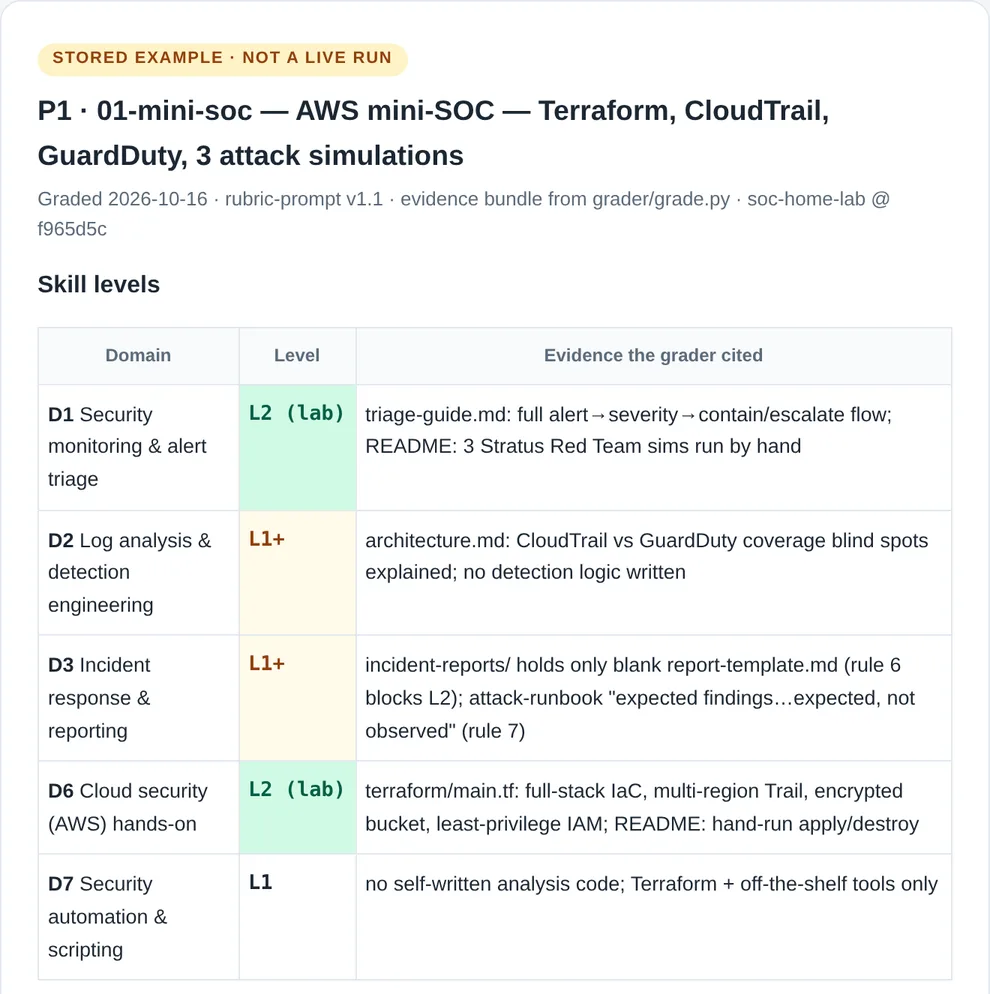
A real grading report, stored — not run live: the founder's own home-lab projects, graded on 2026-10-16 with the earlier rubric v1.1 and published in grader/validation-v1.1.md (the D1–D7 criteria are unchanged in the current rubric v1.3). Pick a project to see its skill levels, the evidence behind each one, and the gap analysis.
Skill levels
Process (behavioral) scores
Overall:
Show the raw grading report (verbatim)
Levels: L1 = guided · L1+ = beyond L1, short of L2 · L2 = independent hands-on, with scope (lab / synthetic / reconstructed). L3 (production) is never self-awarded. Combined across all five projects, this becomes the sample profile below. Advisory output from an AI grader — not a certification.
01 · ASSESSSelf-assessment
No key
Two questions per domain. Answer honestly — the honesty check at the end downgrades anything you can't evidence.
Scoring: Yes = 1 pt, Partially = 0.5 pts per question — partial progress counts, even before you level up.
Your profile
The 6-second one-liner goes at the top of your resume. The 30-second summary is ATS-parseable plain text.
Multi-hat readiness matrix
A portfolio of proven skills, not a portfolio of badges. How many hats can you wear — at a glance.
Gap analysis — what's missing for a SOC role
Every domain below L2, with the next level's bar and free or well-known places to learn it. Certs and platforms teach; your own evidence is what moves the level.
30-second summary
Add it to your GitHub profile README. It links back here so others can assess themselves.
What next? → Run a CVE lab card · Grade your evidence with AI · Track your velocity
Résumé / LinkedIn one-pager
A printable one-page summary of this profile — levels, gaps and an honest disclaimer. Opens in a new tab; use your browser's Print → Save as PDF.
Verification package NEW
A small JSON file containing this profile plus a SHA-256 hash of its contents. On the Verify page anyone can recompute the hash: a match proves the file is unchanged since the hash was made — not that the content is true or who made it (it isn't a signature). For a dated record, post the hash in a free public GitHub gist — how.
02 · AI GRADINGAI grading BETA
Your key
Self-assessment is a claim. Grading is the check. Paste your evidence, bring your own API key — the rubric grades it, right here in your browser. Your key never leaves this device except to the API provider you choose.
1 · Your API key (free signup · free models — grading costs $0)
Get a free key at openrouter.ai/keys (no credit card). The default model is free — any model ending in :free costs $0 on OpenRouter. Paid models work too if you set a spend limit. Stored only in this browser's localStorage. Sent directly to your chosen provider — never to our servers (there are none). OpenAI's own API blocks browser calls (CORS); OpenRouter allows them. Forget my key
2 · Your evidence
Paste a project README, an evidence bundle, or a plain description of what you built and ran. Be specific: file names, what you ran by hand, test counts. The grader only credits observable evidence.
No key yet? Try with sample evidence — loads a real evidence bundle and its stored grading report, no key needed.
03 · LAB CARDSCVE lab cards NEW
Weekly
Weekly vulnerability-driven challenges: mechanics → repro → detection → remediation. Built from public CVE data; every card is original work. Tap a card for the full brief.
Worked a card? Grade your evidence with AI — the grader only credits what you can show.
New cards land weekly from the intel feed (CISA KEV first).
04 · PROGRESSProgress & learning velocity
Export
Every assessment is saved on this device. Re-assess over time — the curve measures trajectory. Employers buy future performance; this is the closest thing to measuring it.
05 · DOMAINSBrowse by domain
8 domains
Eight domains, one rubric. Tap a card for the full level definitions. L3 is never self-awarded — that's the honesty line.
Legend: LAB-READY home-lab project mapped · CORE assessed in every profile · NEW added this month · matrix L1+ = partial evidence (counts 0.5 pts) · L1+* = L2 claimed without the evidence pledge.
06 · SAMPLESample profile
Founder
A real self-assessment by the project founder — 5 home-lab projects, AI-graded with rubric v1.1 on 2026-10-16 (report in grader/). Rated by the author's own rubric, not by independent reviewers — see limitations.
| Domain | — | L1 | L1+ | L2 |
|---|---|---|---|---|
| D1 Monitoring & triage | L2 (lab) | |||
| D2 Log analysis & detection | L1+ | |||
| D3 Incident response | L1+ | |||
| D4 Phishing analysis | L2 (rec.) | |||
| D5 Binary triage | L2 (syn.) | |||
| D6 Cloud (AWS) | L2 (lab) | |||
| D7 Automation & scripting | L2 | |||
| D8 AI agent security & governance | not yet assessed (domain added 2026-10-20) | |||
Scope suffixes: lab = self-built environment, rec. = reconstructed sample, syn. = synthetic data. D3 downgraded to L1+ on 2026-10-16 (blank template ≠ filled report — the rubric working as intended). L3 column intentionally empty.
HOW IT WORKSThree steps from labs to a gap list
3 steps
The journey every candidate takes — assess what you can do, build evidence that proves it, get it graded against the public rubric.
Assess
Answer 16 questions across 8 SOC domains. Sign the evidence pledge — anything you can't evidence gets downgraded.
Start assessing →Build evidence
Run weekly CVE lab cards: mechanics → repro → detection → remediation. Every card maps to NICE domains.
Browse lab cards →Get graded
Paste your evidence, bring your own API key. The AI grades it against the public rubric — in your browser, key never leaves your device.
Grade evidence →WHY SOC-SKILLSGap analysis for SOC job seekers — a complement to certs, not a replacement.
About
Certs like Security+ or CySA+, BTL1, and platforms like TryHackMe and Hack The Box teach and test knowledge. soc-skills answers a different question: given the work you can actually show, what are you still missing for a SOC analyst role, and where do you learn it? It grades your lab write-ups and code against a public rubric — 8 SOC skill domains mapped to the NIST NICE framework, with levels you can only earn with evidence.
- Know where you stand: a level per domain (L1 → L2), each one tied to the file or report that earned it — ready to walk through in an interview.
- Know what to build next: a gap analysis spells out what's missing for the next level, domain by domain — with links to TryHackMe, LetsDefend, CyberDefenders, MITRE ATT&CK and more.
- Show it, don't claim it: a résumé one-liner, a printable one-pager, and a hash-checked profile file (it proves the file is unchanged, not that it's true). Runs in your browser — no soc‑skills account needed.
Or start with the 16-question self-assessment — no key needed. Not a certification; not affiliated with or endorsed by NIST, NICE or any employer.
METHOD · LIMITATIONSHow far to trust the scores
Rubric v1.3
Current rubric: v1.3 (2026-10-20), the version the live grader and new packages use. Read the rubric · domain definitions.
Changelog
- v1.3 · 2026-10-20 — adds D8 AI agent security & governance (8 domains). D1–D7 criteria and grading rules unchanged.
- v1.2 · 2026-10-17 — prompt-injection resistance (evidence is treated as data) + calibration anchors.
- v1.1 · 2026-10-16 — behavioral (process) scores. The stored example and sample profile were graded with this version.
- v1.0 · 2026-10-15 — first rubric and grader.
Older packages still verify; the Verify page links each package to the rubric text of the version it names.
Limitations
- Small, self-made validation set. The rubric was checked on the author's own 5 home-lab projects, against the author's own ratings with the author's own rubric. The reported 14/15 agreement is AI-vs-author, not AI-vs-independent experts.
- No human-rater comparison yet. No SOC practitioner has blind-rated the samples, so there is no inter-rater reliability data (e.g. agreement between two humans, or human vs AI).
- AI grades can vary between runs. Free and small models can give different levels for the same evidence. Run-to-run variance has not been measured; the evaluator-independence results in the repo are illustrative, not measured. Re-run and compare before relying on a grade.
- Evidence is taken at face value. The grader reads what you paste; it does not run your code or confirm you did the work. Verify in an interview or work sample.
- Not a certification. Levels are advisory. They don't replace Security+, CySA+, BTL1 or hands-on platforms — they point you at what to learn next.
Help validate: blind-rate a sample
Work in a SOC, or hire for one? Rate one of the public sample evidence bundles with the rubric before looking at the AI's grade, and submit your levels. Ratings are public and will be published as inter-rater data — agreements and disagreements both.
FAQQuestions new users ask
7 answers
- Does this replace Security+, CySA+, BTL1, TryHackMe or Hack The Box?
- No — it complements them. Certs and platforms teach and test knowledge; soc-skills is a gap analysis of the work you can show. It tells you what's missing for a SOC analyst role and links to where to learn each gap (TryHackMe SOC Level 1, LetsDefend, CyberDefenders, BTL1, CompTIA objectives, MITRE ATT&CK).
- Is this a certification?
- No. Grading is advisory and evidence-based. soc-skills is not affiliated with or endorsed by NIST, NICE, CompTIA, Security Blue Team, TryHackMe, Hack The Box or any employer. L3 (production) is never self-awarded.
- Do I need an account or an API key?
- No account, ever. The example, the self-assessment, the lab cards and the Verify page need no key. Only live AI grading needs your own key — free OpenRouter models cost $0.
- Where does my data go?
- Nowhere. Everything runs in your browser and history stays on this device. Your evidence and key are sent only to the API provider you choose, and only when you click Grade. Page views are counted anonymously with GoatCounter — no cookies, and nothing you type.
- What do the levels mean?
- L1 = guided · L1+ = beyond L1, short of L2 · L2 = independent hands-on, with scope (lab / synthetic / reconstructed) · L3 = production, never self-awarded.
- What does a verification package prove?
- Only that the file is unchanged since its SHA-256 hash was made, and which rubric version it claims. It is not a signature: it doesn't prove the content is true or who made it. Posting the hash in a public GitHub gist adds a dated public record. Try the Verify page.
- How reliable are the scores?
- Unproven so far: the rubric has only been checked on the author's own projects, with no independent human raters yet, and AI grades can vary between runs. Read the limitations — and help validate if you work in a SOC.
07 · GO DEEPERGo deeper
Methodology
The profile is the surface. Underneath: graded evidence, original lab work, and a public rubric.
Grading prompt + validation report (v1.1 round, author's own 5 projects). Behavioral dimension included.
grader/ → CVE lab cardsWeekly vulnerability-driven challenges: mechanics → repro → detection → remediation.
labs/ → Feedback → productEvery principle earned from someone pushing back. The debate log.
FEEDBACK.md → Home labThe 5 working projects behind the sample profile. Real code, real runs.
soc-home-lab →08 · SUPPORTSupport
Email · bugs
Found a bug, confused by a grade, or want a lab card for a CVE you care about? Write to us — a human reads every email.
Bug reports: browser + device, what you clicked, what happened vs what you expected.
Feature ideas and CVE lab requests welcome.